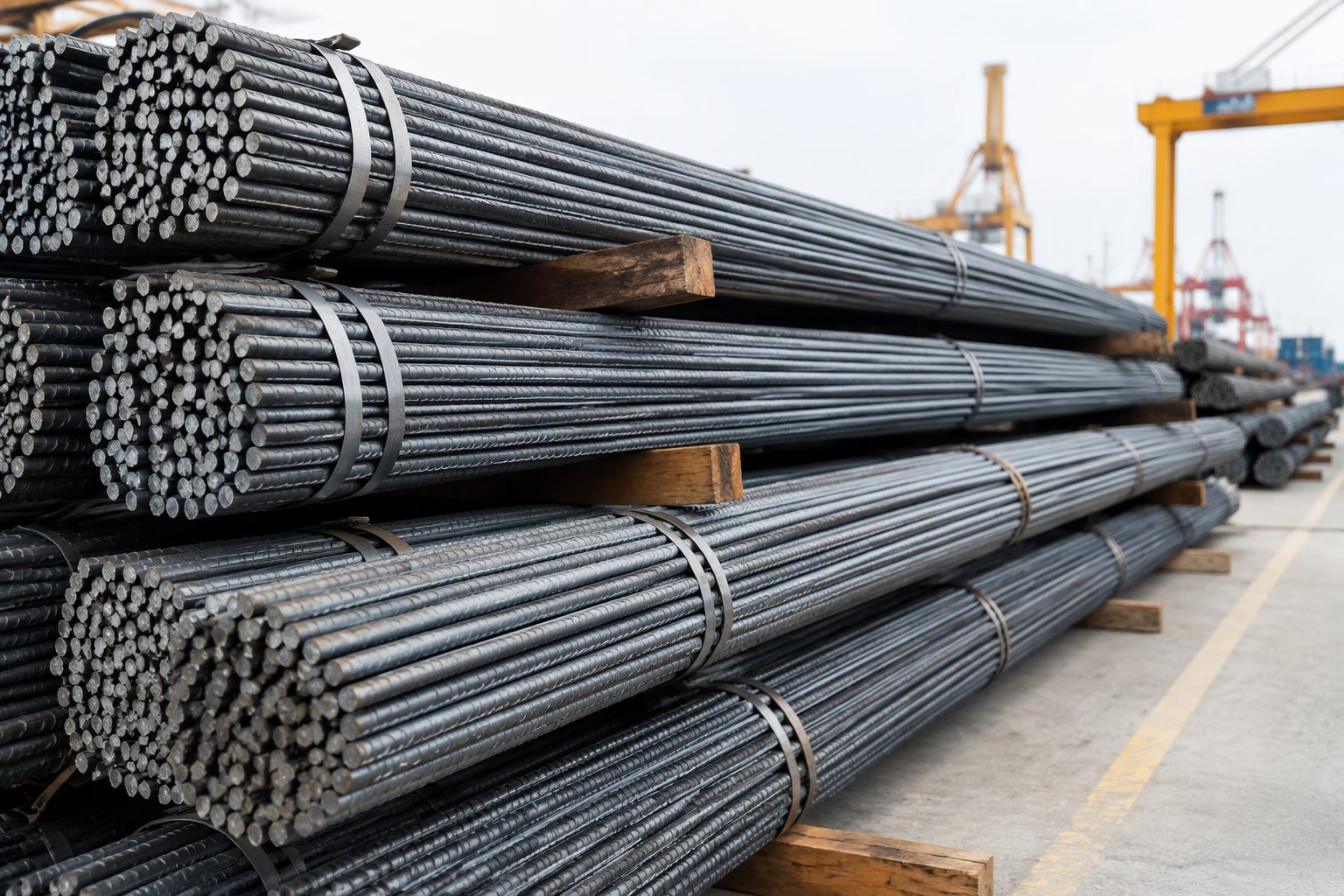
In reinforced concrete design, steel rebar is the primary tensile workhorse that prevents structural failure under bending, shear, and seismic loading. From high-rise commercial towers and industrial foundation rafts to highway bridges and marine breakwaters, specifying the correct rebar standard directly dictates structural ductility, crack control, and earthquake resilience.
In international civil engineering procurement—particularly across the Middle East (GCC), United Kingdom, Africa, and Southeast Asia—contractors and commercial buyers encounter two dominant, competing standard families:
- British and European Standards: BS 4449 (Steel for the reinforcement of concrete) and EN 10080 (Steel for the reinforcement of concrete – Weldable reinforcing steel), typified by Grade B500B and high-ductility B500C.
- American Standards: ASTM A615 (Deformed and Plain Carbon-Steel Bars for Concrete Reinforcement), represented universally by Grade 60 (420 MPa) and Grade 75 (520 MPa), alongside its seismic-rated counterpart ASTM A706.
While project managers often treat 500 MPa European rebar and 420 MPa American rebar as simple yield strength equivalents, substituting between them without accounting for characteristic ductility (Rm / Re ratio), uniform strain at maximum force (Agt), relative rib area (fR), and carbon equivalent weldability (CEV) can result in critical structural code violations, failed bend-rebend tests, and project shutdowns.
This comprehensive technical guide provides an exhaustive engineering comparison of BS 4449 B500B/B500C, ASTM A615 Grade 60, and EN 10080 reinforcing steel standards, detailing mechanical limits, chemical metallurgy, rib geometry bond efficiency, seismic design mandates (Eurocode 2 / ACI 318), and on-site quality verification.
Key facts at a glance
- Yield strength divergence: BS 4449 Grade B500B specifies a characteristic yield strength (Re) of 500 MPa (72,500 psi), whereas standard ASTM A615 Grade 60 specifies a minimum yield strength of 420 MPa (60,000 psi). Stepping from Grade 60 to B500B provides an immediate 19% increase in tensile load capacity, allowing structural engineers to reduce rebar congestion in heavily reinforced columns and transfer beams.
- The critical ductility ratio (Rm / Re): In modern earthquake engineering, high tensile strength alone is dangerous without adequate ductility. BS 4449 B500B mandates an ultimate tensile to yield strength ratio (Rm / Re) of at least 1.08, while seismic Grade B500C requires 1.15 ≤ Rm / Re ≤ 1.35. Standard ASTM A615 sets no maximum upper yield cap and no mandatory Rm / Re ratio, making standard A615 Grade 60 prohibited in high-seismic moment frames under ACI 318 Chapter 18 without special testing.
- Total elongation at maximum force (Agt): European and British standards evaluate uniform plastic strain using Agt (minimum 5.0% for B500B and 7.5% for B500C). ASTM A615 measures total post-fracture elongation over an 8-inch gauge length (typically 9% to 10%), which includes the localized necking zone and cannot be directly compared to Agt.
- Weldability & Carbon Equivalent (CEV): BS 4449 explicitly certifies fully weldable reinforcing steel with carbon content ≤ 0.22% and CEV ≤ 0.50%. Conversely, standard ASTM A615 is non-weldable without complex preheat engineering; projects requiring field welding under American codes must specify ASTM A706 Grade 60.
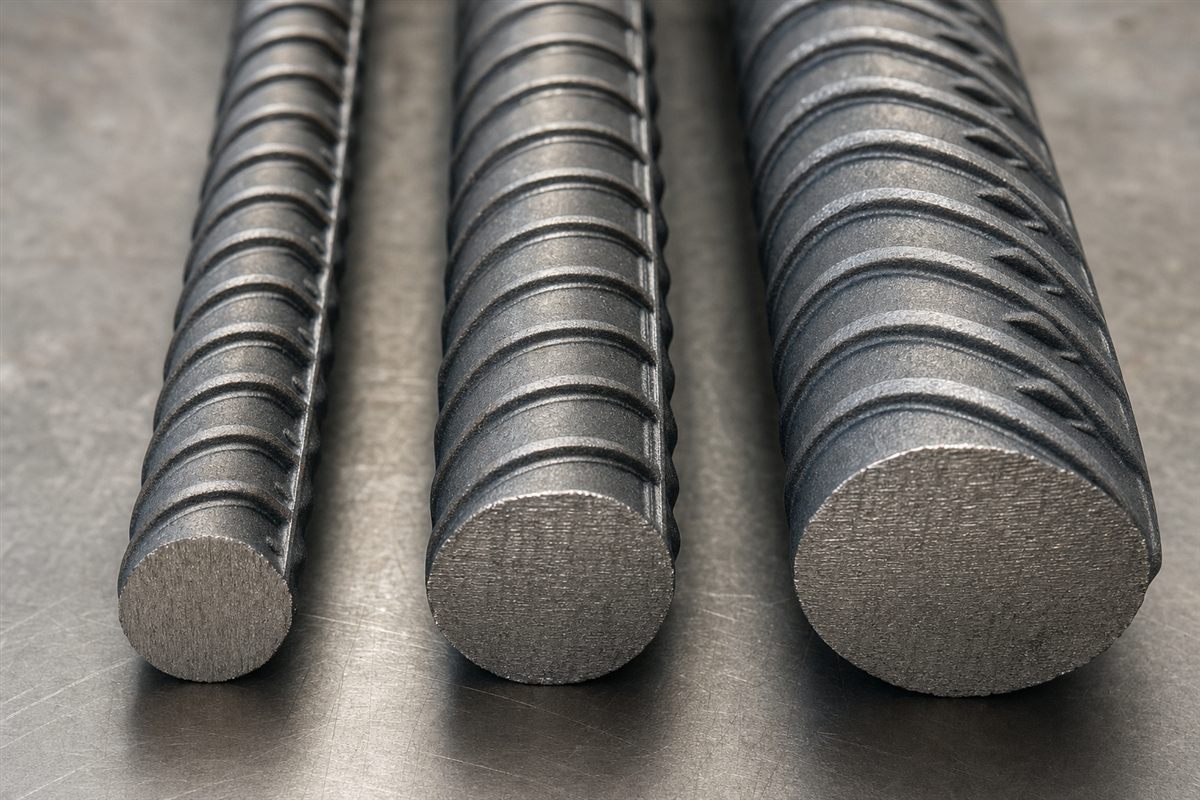
- Rib geometry and bond behavior (fR): European EN 10080 and BS 4449 mandate a verified relative rib area (fR ≥ 0.045 to 0.056) and specific transverse rib angles (45° to 75°) to ensure predictable mechanical interlock with concrete and control flexural crack widths.
The international standards landscape: BS 4449, EN 10080, and ASTM A615
To understand global rebar supply chains, engineers must navigate the governing standards frameworks:
1. BS 4449 (2005+A3:2016) and EN 10080
Published by BSI and harmonized under European mandates, BS 4449 governs weldable reinforcing steel bars, coils, and decoiled products. It establishes three standard ductility classes for 500 MPa steel:
- B500A (Low Ductility / Normal): Re ≥ 500 MPa, Rm/Re ≥ 1.05, Agt ≥ 2.5%. Primarily used for prefabricated factory mesh and light slabs.
- B500B (Medium Ductility / Standard Commercial): Re ≥ 500 MPa, Rm/Re ≥ 1.08, Agt ≥ 5.0%. The universal standard for general commercial building columns, beams, and foundations.
- B500C (High Ductility / Seismic Grade): Re ≥ 500 MPa, 1.15 ≤ Rm/Re ≤ 1.35, Agt ≥ 7.5%. Mandatory for earthquake-resistant infrastructure, nuclear facilities, and deep bridge pilings under Eurocode 8.
2. ASTM A615 / A615M vs. ASTM A706 / A706M
In North America, Latin America, and US-designed projects across the Middle East, structural engineers design according to American Concrete Institute (ACI 318) codes:
- ASTM A615 (Billet Steel): The high-volume commercial rebar specification covering Grade 40 (280 MPa), Grade 60 (420 MPa), Grade 75 (520 MPa), Grade 80 (550 MPa), and Grade 100 (690 MPa). It focuses strictly on yield, tensile, and standard bend performance.
- ASTM A706 (Low-Alloy Steel): Specifically engineered for seismic resistance and welding. It places a strict 18,000 psi (125 MPa) cap on actual yield strength over nominal (420–545 MPa) and mandates a minimum tensile-to-yield ratio of Rm / Re ≥ 1.25.
As explored in our technical breakdown of scaffolding tube standards and steel structural integrity, civil engineering works rely on verified metallurgical ductility to prevent brittle collapse.
Mechanical performance comparison table
The following engineering reference table directly compares the chemical, mechanical, and elongation properties of BS 4449 B500B, BS 4449 B500C, ASTM A615 Grade 60, and ASTM A706 Grade 60:
| Technical Parameter | BS 4449 Grade B500B | BS 4449 Grade B500C (Seismic) | ASTM A615 Grade 60 (Standard) | ASTM A706 Grade 60 (Seismic/Weldable) |
|---|---|---|---|---|
| Governing Standard | BS 4449:2005 / EN 10080 | BS 4449:2005 / EN 10080 | ASTM A615 / A615M-22 | ASTM A706 / A706M-22 |
| Specified Characteristic Yield Strength (Re / fy) | 500 MPa (72.5 ksi) | 500 MPa (72.5 ksi) | 420 MPa (60.0 ksi) | 420 MPa (60.0 ksi) |
| Maximum Permissible Actual Yield Strength | 1.30 × Re (650 MPa) | 1.30 × Re (650 MPa) | No Upper Cap Specified | 540 MPa (78.0 ksi) |
| Minimum Tensile Strength (Rm / fu) | 540 MPa (78.3 ksi) | 575 MPa (83.4 ksi) | 620 MPa (90.0 ksi) | 550 MPa (80.0 ksi) |
| Tensile / Yield Ratio (Rm / Re) | ≥ 1.08 | 1.15 ≤ Rm/Re ≤ 1.35 | No Minimum Specified | ≥ 1.25 |
| Uniform Strain at Peak Force (Agt) | ≥ 5.0% | ≥ 7.5% | Not Standardized (Agt not tested) | Not Standardized |
| Fracture Elongation in 8″ (200 mm) | Not Standardized (Uses Agt) | Not Standardized (Uses Agt) | 9.0% to 10.0% (by size) | 12.0% to 14.0% (by size) |
| Maximum Carbon Content (Cast) | ≤ 0.22% | ≤ 0.22% | No limit (Typically 0.40%–0.50%) | ≤ 0.30% |
| Maximum Carbon Equivalent (CEV) | ≤ 0.50% | ≤ 0.50% | Not Standardized (Non-Weldable) | ≤ 0.55% |
| Mandatory Rebend Testing | Yes (90° bend + 20° rebend) | Yes (90° bend + 20° rebend) | No (Standard 180° cold bend only) | No (Standard 180° cold bend only) |
Why ductility and the Rm/Re ratio govern seismic design
In structural concrete design under Eurocode 2/8 and ACI 318-19, catastrophic building collapse is prevented through the principle of Capacity Design.
1. Plastic hinge formation in beams and columns
During an earthquake, a reinforced concrete frame must absorb and dissipate massive ground energy through controlled plastic yielding at predetermined beam ends (plastic hinges) without brittle shear failure in columns:
- If rebar yield strength is excessively high without a corresponding upper ceiling (as can occur with unmanaged ASTM A615), the beam steel will not yield as anticipated by the designer.
- Instead, excessive bending moments are transferred directly into the column and joint core, triggering sudden explosive compressive concrete crushing and catastrophic pancake collapse.
2. Why Agt is the superior measure of real ductility
Traditional total elongation measurements (like ASTM’s 8-inch gauge test) measure steel elongation after the specimen has already necked down locally and broken.
In an active building subjected to seismic flexure:
- Once necking initiates, the bar is already locally failing.
- Agt (percentage total elongation at maximum force) measures how much the rebar can stretch uniformly across its entire length before localized necking begins.
- A high Agt (≥ 7.5% in Grade B500C) guarantees that long plastic hinge zones can stretch, absorb dozens of cyclic earthquake reversals, and protect building occupants.
Chemical metallurgy: Thermo-Mechanical Treatment (TMT) vs. Micro-Alloying
Modern high-yield rebar achieves its strength through two distinct steel manufacturing routes:
1. Thermo-Mechanical Treatment (TMT / QST Process)
The dominant global manufacturing route for BS 4449 B500B and ASTM A615 Grade 60 is the continuous in-line Quenched and Self-Tempered (QST) process (such as Tempcore or Thermex):
- Hot-rolled steel bars exiting the final rolling stand at 1,050°C pass through intensive high-pressure water quenching lines for a fraction of a second.
- This rapid cooling transforms the outer surface into an ultra-hard, high-strength Martensitic rim.
- As the bar moves onto the cooling bed, the intense residual heat in the core (approx. 850°C) diffuses outward, self-tempering the outer martensite while allowing the inner core to transform into a ductile, highly resilient Ferrite-Pearlite core.
- Advantage: Delivers 500 MPa yield strength using low-carbon steel (C ≤ 0.22%) without expensive alloying elements, ensuring superb weldability and bendability.
2. Vanadium / Niobium Micro-Alloyed Steel
Micro-alloyed rebar achieves uniform grain refinement and precipitation hardening by adding micro-alloys (0.05%–0.10% Vanadium or Niobium) during electric arc furnace melting:
- The bar cools naturally in air, creating a uniform, homogeneous fine-grained ferrite-pearlite structure from core to surface.
- Advantage: Unlike TMT rebar, micro-alloyed rebar maintains full yield strength even after high-temperature exposure, threading, or heavy forging, making it ideal for specialized mechanical couplers and high-heat industrial anchors.
Deformed rib patterns and relative rib area (fR)
To transfer high tensile forces into surrounding concrete without slipping, rebar features raised transverse ribs. In international standards, bond efficiency is mathematically quantified as the Relative Rib Area (fR):
fR = AR / (π · d · c)
Where AR is the projected area of the transverse rib on a plane perpendicular to the bar axis, d is nominal diameter, and c is rib center-to-center spacing.
As analyzed in our foundation guide on Ringlock vs Cuplock scaffolding engineering, precise mechanical interlocks are fundamental to structural load transfer.
International procurement, container packing, and weight conversions
Steel reinforcing bars are priced and transported internationally strictly on a theoretical metric weight basis (kg/m or metric tons). Understanding international bar size equivalents is essential for accurate quantity surveying.
Metric vs. Imperial Rebar Size Cross-Reference Table
| Metric Rebar Size (ϕ) | Nominal Area | Nominal Weight (kg/m) | Closest ASTM Imperial Bar Size | ASTM Nominal Area | ASTM Nominal Weight (lb/ft / kg/m) | Weight Difference |
|---|---|---|---|---|---|---|
| ϕ 8 mm | 50.3 mm² | 0.395 kg/m | #3 (3/8″) | 71.0 mm² | 0.376 lb/ft (0.560 kg/m) | Imperial is +41.8% |
| ϕ 10 mm | 78.5 mm² | 0.617 kg/m | #3 (3/8″) | 71.0 mm² | 0.376 lb/ft (0.560 kg/m) | Metric is +10.2% |
| ϕ 12 mm | 113.1 mm² | 0.888 kg/m | #4 (1/2″) | 129.0 mm² | 0.668 lb/ft (0.994 kg/m) | Imperial is +11.9% |
| ϕ 16 mm | 201.1 mm² | 1.580 kg/m | #5 (5/8″) | 200.0 mm² | 1.043 lb/ft (1.552 kg/m) | Identical (≈ 0.5%) |
| ϕ 20 mm | 314.2 mm² | 2.470 kg/m | #6 (3/4″) | 284.0 mm² | 1.502 lb/ft (2.235 kg/m) | Metric is +10.5% |
| ϕ 25 mm | 490.9 mm² | 3.850 kg/m | #8 (1.00″) | 510.0 mm² | 2.670 lb/ft (3.973 kg/m) | Imperial is +3.2% |
| ϕ 32 mm | 804.2 mm² | 6.310 kg/m | #10 (1-1/4″) | 819.0 mm² | 4.303 lb/ft (6.404 kg/m) | Imperial is +1.5% |
| ϕ 40 mm | 1,256.6 mm² | 9.860 kg/m | #11 (1-3/8″) | 1,006.0 mm² | 5.313 lb/ft (7.907 kg/m) | Metric is +24.7% |
Ocean freight container stuffing (12-Meter Rebar Bundles)
Export rebar is delivered in standard 12.0-meter lengths (39.37 feet), tied in 2.0 metric ton master bundles:
- In a standard 40-foot container (internal length: 12.03 m), 12m rebar bundles fit precisely end-to-end.
- A 40HQ container reaches its maximum payload limit at 26.5 to 28.0 metric tons (approx. 13 to 14 master bundles).
- For large port projects, breakbulk ocean vessels transport bulk bundles up to 50,000 metric tons per sailing.
6-Step Receipt Quality Inspection Checklist
When offloading rebar shipments at construction yards or port facilities, QA/QC engineers should execute this standard 6-step testing protocol:
- Verify Mill Test Certificate (MTC): Ensure the EN 10204 Type 3.1 MTC lists heat numbers matching physical metal tags on bundles, confirming yield strength (≥ 500 MPa for B500B; ≥ 420 MPa for Gr 60), Rm/Re ratio, Agt, and CEV ≤ 0.50%.
- Measure nominal mass per meter (Weight Test): Cut a minimum of three 1.0-meter test samples per heat lot, deburr cut ends, and weigh on a calibrated analytical balance; mass per meter must fall strictly within ±4.5% (ϕ ≥ 12 mm) of theoretical standard tables.
- Tensile and Elongation Testing: Perform laboratory tensile pull tests on full-section unmachined bar samples to verify yield plateau, peak tensile strength, and uniform elongation (Agt).
- Mandatory 90° Bend & 20° Rebend Test: Under BS 4449 rules, bend test samples through 90° around a standard former diameter (4d or 5d), artificially age in boiling water at 100°C for 30 minutes, cool to room temperature, and bend back by 20°; the sample must show zero surface cracking or transverse tearing.
- Inspect surface rust condition: Light reddish-brown atmospheric surface rust (flaking scale) is beneficial for concrete bond development and is commercially acceptable under ASTM A615 Section 12 and BS 4449. Heavy pitting that reduces measured cross-sectional area below dimensional tolerance limits is an automatic reject.
- Verify raised mill identifying marks: Confirm the roll-embossed mill marks along the bar spine identify the country of origin, registered mill number, and designated grade.
FAQ
Can BS 4449 B500B directly replace ASTM A615 Grade 60 on a construction site?
Yes, structurally B500B provides higher yield strength (500 MPa vs 420 MPa) and superior weldability, easily satisfying Grade 60 load demands. However, substituting it requires formal approval from the Consulting Structural Engineer of Record to ensure beam-column joint shear ratios and development lap splice lengths are appropriately adjusted.
Can ASTM A615 Grade 60 rebar be welded?
Standard ASTM A615 rebar contains high carbon (0.40%–0.50%) and is not guaranteed for field welding. Welding A615 creates brittle untempered martensite in the heat-affected zone (HAZ), leading to catastrophic snap fractures under load. If field welding is required on American-standard projects, specify ASTM A706 Grade 60.
What is the difference between Grade B500B and Grade B500C?
Both share a 500 MPa yield strength, but B500C is high-ductility seismic grade. B500C mandates a higher tensile-to-yield ratio (Rm/Re ≥ 1.15 to 1.35) and higher uniform elongation (Agt ≥ 7.5%, compared to 5.0% for B500B), making B500C mandatory in high-seismic zones under Eurocode 8.
How does TMT rebar achieve high strength without high carbon?
TMT (Thermo-Mechanical Treatment) applies rapid water quenching as the red-hot steel bar exits the rolling mill, creating a high-strength martensite outer ring while preserving a ductile, low-carbon ferrite-pearlite core.
Why is rebend testing important for reinforcing steel?
Rebar is bent into hooks, stirrups, and column links on site, and then frequently straightened or adjusted. The 90° bend followed by artificial heat aging and a 20° reverse bend verifies that the steel does not exhibit strain-age embrittlement.
What is the standard export bundle weight for rebar?
Standard international export bundles weigh approximately 2.0 metric tons (2,000 kg), strapped at 6 points with heavy steel banding and tagged with weatherproof metal barcodes listing heat number, size, grade, and length.
Does surface rust affect rebar bond strength with concrete?
Normal atmospheric surface rust (tight brown oxide) actually increases mechanical friction and micro-bond strength between the steel and concrete matrix. Only heavy scaling rust that flakes off in thick layers and reduces cross-sectional steel area is detrimental.
What is the difference between deformed rebar and plain round bar?
Deformed rebar features raised transverse ribs that mechanically lock into concrete, increasing pull-out bond strength by over 300% compared to smooth plain round bar (which relies solely on chemical adhesion and friction).
Bottom line
- Specify BS 4449 Grade B500B as your primary commercial standard for high-rise residential, commercial framing, and foundation engineering across Commonwealth, European, and Middle East markets to maximize load capacity (500 MPa) while maintaining excellent ductility and weldability.
- Specify BS 4449 Grade B500C or ASTM A706 Grade 60 whenever designing structures in active seismic zones, nuclear facilities, or heavy civil bridge structures governed by Eurocode 8 or ACI 318 Chapter 18.
- Never allow uncontrolled field welding of standard ASTM A615 Grade 60 rebar; mandate ASTM A706 or BS 4449 with certified CEV ≤ 0.50%.
- Enforce mandatory on-site receiving inspections: verify EN 10204 Type 3.1 MTCs, run 1-meter analytical weight checks, and conduct 90° bend-rebend tests to guarantee compliance before steel is placed in formwork.
For more technical guides on structural steel reinforcement, scaffolding systems, and access engineering standards, explore our complete library in the Scaffolding & Structural Systems category.