
When a commercial tender lands on an estimator’s desk, scaffolding is too often treated as a generic bulk hire item. But for contractors managing large-scale industrial projects, complex civil structures, or heavy shoring, the scaffolding system you specify directly governs labor costs, erection cycles, and site safety. The three modular workhorses dominating international construction today are Ringlock, Cuplock, and Kwikstage.
While all three replace the slow, labor-intensive tube-and-coupler method with pre-engineered connection nodes, their mechanical behavior, flexibility around non-linear geometries, and load-bearing capacities are fundamentally different. Choosing the wrong system means either blowing the crane budget on unnecessary steel tonnage or watching your scaffolding crew struggle with alignment on a curved facade. This guide delivers a rigorous, field-tested comparison of all three modular systems to help project managers and procurement heads specify the right scaffolding system for their site.
Key facts at a glance
- Ringlock (Allround) is the most versatile and rigid modular system, featuring an 8-hole rosette welded every 500 mm along the vertical standard, allowing connections at variable angles up to 360 degrees.
- Cuplock is the industry benchmark for heavy-duty shoring and repetitive rectangular structures, using a rotating cast-iron top cup to lock up to four horizontal components simultaneously with a single hammer blow.
- Kwikstage is a straightforward, wedge-and-pocket system widely established in residential and medium-rise masonry access across the UK, Australia, and South Africa.
- Erection speed: Cuplock and Ringlock assemble up to 40% to 50% faster than traditional tube-and-fitting systems, significantly lowering erection labor costs.
- Curved and irregular geometry: Ringlock is the undisputed leader for circular tanks, offshore platforms, bridges, and complex architectural facades due to its multi-directional rosette geometry.
- Heavy shoring capacity: Cuplock and Ringlock provide superior axial capacity (often exceeding 40 kN to 60 kN per standard depending on unbraced lift height and steel grade like S355).
Mechanical breakdown: how the connection nodes work
The true difference between modular scaffolding systems lies in the connection node. The node dictates how horizontal ledgers and diagonal braces lock into the vertical standard, how loads transfer down the axial column, and how fast a scaffolder can secure the joint.
1. Ringlock node: the multi-directional rosette
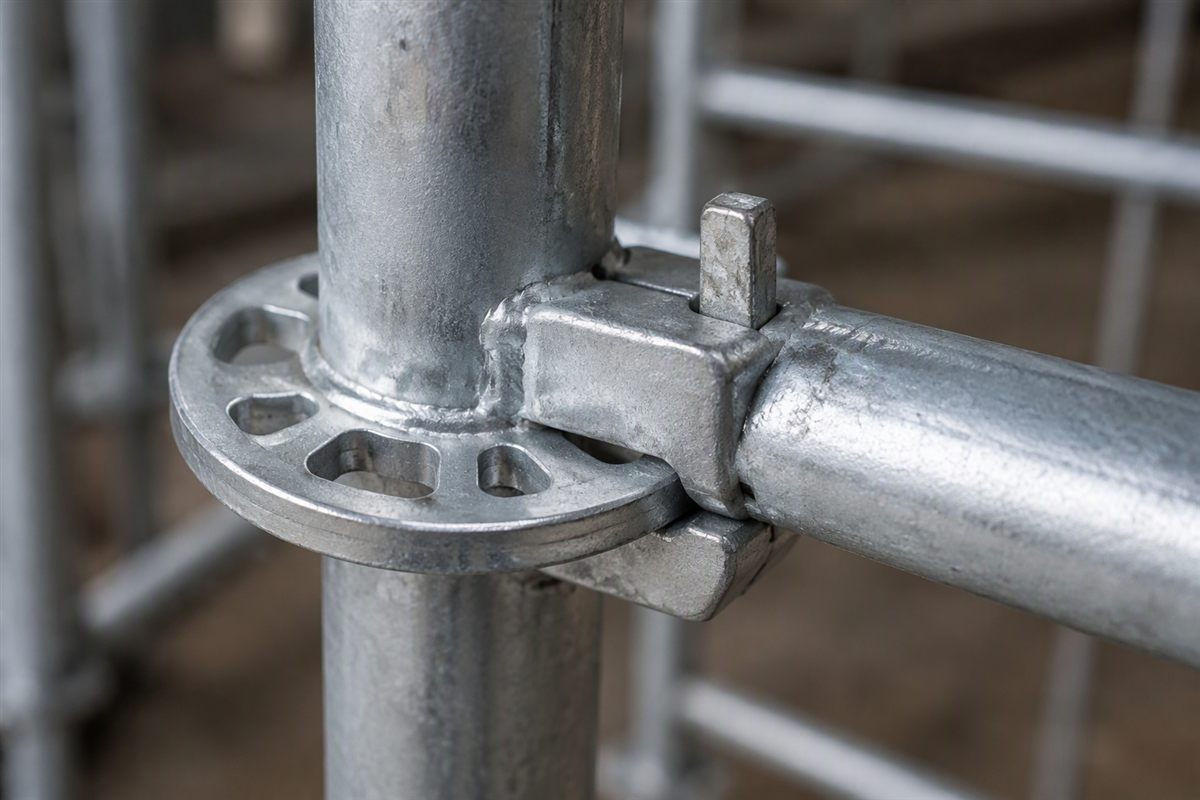
A Ringlock standard consists of a high-strength structural steel tube (typically 48.3 mm OD with 3.2 mm or 3.25 mm wall thickness in Q355/S355 steel) featuring forged or stamped steel rosettes welded at fixed 500 mm vertical centers.
Each rosette features eight precision-engineered openings:
- Four small holes positioned at exact 90-degree right angles for primary horizontal ledgers and transoms.
- Four larger trapezoidal slots arranged between the right angles, allowing diagonal braces and angled ledgers to connect at variable angles across a 360-degree radius.
The ledger ends feature cast steel wedge heads that slip over the rosette profile. A captive high-tensile steel wedge pin is dropped through the slot and hammered firmly home. This wedge action creates a positive frictional and mechanical interlock that transfers bending moments and axial forces with exceptional rigidity.
2. Cuplock node: the four-in-one captive locking cup
Cuplock relies on a simpler, robust node design consisting of two cups:
- A fixed bottom cup welded to the vertical standard at 500 mm intervals.
- A sliding malleable iron top cup with internal spiral cam lugs.
To make a connection, the forged blade ends of up to four horizontal ledgers are seated into the fixed bottom cup. The top cup is dropped over the blades, rotated by hand, and struck with a hammer. The internal spiral cam drives the top cup downward, compressing the four ledger ends firmly into the bottom cup.
The standout mechanical advantage of Cuplock is that a single node locking operation secures up to four components simultaneously without loose bolts, nuts, or separate wedge pins. However, all connections are strictly orthogonal (fixed at 90 degrees), making irregular angles difficult without supplementary swivel couplers.
3. Kwikstage node: the captive wedge and V-pressing
Kwikstage utilizes captive wedges permanently riveted to horizontal ledgers, which slot into heavy-gauge pressed steel “V-pockets” (or drop-forged star pressings) welded to the vertical standard at 495 mm or 500 mm centers.
A scaffolder drops the ledger spigot into the V-pocket and drives the captive wedge pin down using a standard hammer. The wedge pin expands against the pocket wall to lock the connection. Kwikstage is extremely intuitive for general access, but its node provides less rotational stiffness compared to modern Ringlock rosettes, requiring more frequent diagonal bracing under heavy loads.
Scaffolding systems compared: technical specifications
The table below summarizes the key engineering, operational, and commercial parameters of all three systems.
| Technical Parameter | Ringlock Scaffolding | Cuplock Scaffolding | Kwikstage Scaffolding |
|---|---|---|---|
| Node Type | 8-hole Rosette with captive wedge | Fixed lower cup + rotating upper cam cup | Pressed V-pocket with captive wedge |
| Connection Angles | 360° variable (4 fixed 90° + 4 variable slots) | Strictly 90° orthogonal | Strictly 90° orthogonal |
| Max Connections per Node | Up to 8 (4 ledgers + 4 diagonals) | Up to 4 horizontal components | Up to 4 horizontal components |
| Standard Steel Grade | S355 / Q355 high-tensile steel | S235 / S355 structural steel | S235 structural steel |
| Tube Specification | 48.3 mm OD × 3.2 mm / 3.25 mm WT | 48.3 mm OD × 3.2 mm / 3.25 mm WT | 48.3 mm OD × 3.2 mm / 4.0 mm WT |
| Surface Finish | Hot-Dip Galvanized (ISO 1461, ≥55–70 μm) | Hot-Dip Galvanized or Painted | Painted (Enamel) or Hot-Dip Galvanized |
| Typical Leg Load Capacity | Up to 45–65 kN (depending on lift height) | Up to 40–55 kN | Up to 30–45 kN |
| Adaptability to Complex Shapes | Excellent (curved, circular, cantilevers) | Moderate (requires tube & clamp adapters) | Moderate to Low (strictly rectangular) |
| Erection Speed Index | Very Fast (100% baseline) | Very Fast (~95% of Ringlock) | Moderate (~80% of Ringlock) |
| Capital Investment | Highest initial cost | Moderate initial cost | Lowest initial cost |
| Key Compliance Standards | EN 12810, EN 12811, ANSI/SSFI SC100 | EN 12810, BS 1139, OSHA 1926.451 | BS 1139, AS/NZS 1576, SANS 10085 |
Site selection: which system belongs on your project?
Different construction environments demand different performance characteristics. Here is how seasoned project managers match the system to project requirements:
Choose Ringlock for:
- Industrial and petrochemical plants: Refinery pipe racks, power station boilers, and chemical processing facilities require scaffolding that negotiates dense pipework, valves, and angled structural steel. Ringlock’s 360-degree rosette is the only modular system that handles these geometries without reverting to loose tube and couplers.
- Infrastructure and civil engineering: Bridge piers, curved highway overpasses, and tunnel vaults benefit from Ringlock’s ability to construct circular and polygonal layouts smoothly.
- Heavy-duty shoring and falsework: When supporting heavy slab pours or precast bridge segments, Ringlock standards made from S355 steel deliver high axial capacities with integrated high-capacity truss beams.
- Large event staging and temporary grandstands: Rapid assembly, high aesthetic appeal, and flexible deck placements make Ringlock the global standard for temporary public structures.
Choose Cuplock for:
- Repetitive commercial building facades: High-rise residential towers and office blocks with straight rectangular perimeters are ideal for Cuplock. Scaffolding teams can lock four components in a single motion, driving fast floor-by-floor cycle times.
- Heavy falsework and slab propping: Cuplock has decades of proven performance in civil concrete casting, formwork support, and table form systems where heavy vertical loads are concentrated on rectangular grid patterns.
- Industrial maintenance outages: In boiler maintenance and shipyards where rough handling is common, Cuplock’s cast-iron cups tolerate dirt, grit, and repeated hammer strikes better than lighter pressed fittings.
Choose Kwikstage for:
- Residential and low-to-medium rise housing: For bricklaying, masonry work, and exterior cladding on 2-to-6 story residential projects, Kwikstage provides an economical, robust work platform with non-slip steel stage boards.
- Markets with established Kwikstage labor: In regions like the United Kingdom, Australia, New Zealand, and South Africa, scaffolding crews have decades of familiarity with Kwikstage, ensuring maximum productivity and compliance without specialized retraining.
Procurement checklist: material quality and galvanizing standards
When purchasing modular scaffolding systems from international manufacturers, cutting corners on steel metallurgy or surface protection creates severe safety liabilities and accelerates asset depreciation. Here is what to insist on in your purchase contract:
1. Steel grade and mill test certification (MTC)
Insist on mill test certificates conforming to EN 10204 Type 3.1 for every production batch.
- Vertical standards must be fabricated from structural steel with verified minimum yield strength (minimum S355/Q355 for heavy-duty Ringlock/Cuplock, delivering ≥355 MPa yield).
- Wall thickness must comply with EN 12810 standards (48.3 mm OD with tight wall thickness tolerances, never undercut below 3.0 mm).
2. Hot-Dip Galvanizing (ISO 1461)
Scaffolding equipment endures harsh site storage, abrasive handling, and corrosive atmospheric exposure (especially in coastal Gulf regions).
- Specify Hot-Dip Galvanizing to ISO 1461 or ASTM A123 with a minimum average coating thickness of 55 μm to 70 μm (approx. 390–500 g/m²).
- Hot-dip galvanizing protects both the exterior and the interior bore of the tubular standards, preventing internal rust that compromises structural column integrity over time.
- Avoid electro-galvanized (zinc-plated) or dip-painted finishes for commercial scaffolding fleets intended for multi-year reuse.
3. Welding integrity and drop-testing
Rosettes, cups, and spigots must undergo automated welding with 100% visual inspection and regular destructive weld shear testing. For Ringlock, rosette weld shear strength should easily exceed 45 kN to satisfy international testing regimes.
4. Base collars, screw jacks, and ground bearing control
A scaffolding tower is only as reliable as its base load transfer. Always verify that adjustable base jacks feature rolled trapezoidal ACME threads rather than cut threads, providing higher shear strength under concentrated point loads. Base collars (starting collars) should be hot-dip galvanized with integrated rosette or cup fixtures to establish the baseline horizontal bay geometry immediately above sole boards before standards are erected to height.
FAQ
Can I mix Ringlock and Cuplock components on the same scaffold?
No. While both systems utilize 48.3 mm outside diameter steel tubing, their connection nodes (rosettes vs. cups) and component center-to-center dimensions are completely incompatible. Combining them on the same bay compromises structural load paths and voids site safety certifications.
Why is Ringlock considered safer than traditional tube-and-coupler?
Traditional tube-and-coupler scaffolding relies entirely on the frictional grip of individual manual bolt clamps, leaving human error (under-tightened or over-torqued bolts) as a major risk factor. Ringlock features pre-welded nodes at calibrated factory intervals with positive wedge interlocks, ensuring consistent load transfer and geometric squareness.
What is the maximum standard height for Ringlock standards?
Ringlock vertical standards are typically manufactured in standard lengths of 0.5 m, 1.0 m, 1.5 m, 2.0 m, 2.5 m, and 3.0 m, with integrated spigot pins for vertical stacking to any engineered height supported by tie-ins and structural calculations.
Is Cuplock cheaper than Ringlock?
Generally, yes. Cuplock has a simpler node design with fewer precision laser-cut parts, making its manufacturing cost approximately 10% to 20% lower than Ringlock. However, Ringlock’s superior adaptability on complex layouts often claws back this difference through reduced labor hours on site.
How does galvanizing thickness affect scaffolding lifespan?
Hot-dip galvanized scaffolding with a 60–70 μm zinc coating conforming to ISO 1461 typically delivers a service life of 15 to 20+ years under outdoor site conditions. In contrast, painted scaffolding requires repainting every 2–3 years and rapidly develops interior tube corrosion.
What scaffold system is best for circular storage tanks?
Ringlock is the industry standard for circular tanks, silos, and gas holders. Its 8-hole rosette allows ledgers and bay configurations to wrap around circular perimeters at smooth incremental angles without requiring specialized adapter brackets.
What standards govern modular scaffolding compliance?
The primary international benchmarks are EN 12810-1 / EN 12811-1 (European facade and working scaffold standards), ANSI/SSFI SC100 (American national standard), and BS 1139 / AS/NZS 1576 (British and Australian/New Zealand standards).
What tools does a scaffolder need to erect Ringlock or Cuplock?
Both systems require minimal tooling: a 500 g to 1 kg scaffolding hammer for driving wedges or locking cups, a magnetic spirit level for plumbing standards, a 5 m tape measure, and personal fall arrest equipment.
How do tie-in intervals differ between systems on high-elevation facades?
Facade tie-in patterns are governed primarily by wind loads and facade sheeting rather than node type. Under EN 12810 guidelines, unclad scaffolding typically requires facade anchor ties every 4 meters vertically and 8 meters horizontally on alternate standards. When debris netting or printed banners are installed, the resulting wind drag requires doubling the tie frequency to prevent catastrophic overturning moments.
How much scaffolding material fits into a standard 40ft High Cube container?
A 40ft HC container typically accommodates 24 to 26 metric tons of modular scaffolding components when packed on custom steel stillages or bundled pallets. Ringlock ledgers and standards bundle more compactly than Kwikstage due to the slim rosette profile, yielding approximately 8% to 12% higher volumetric efficiency during ocean shipping.
Bottom line
- Choose Ringlock when your projects involve complex architectural geometries, industrial pipework, circular structures, or heavy falsework where flexibility and high strength justify a premium initial investment.
- Choose Cuplock for high-volume rectangular commercial facades and heavy civil shoring where rapid four-in-one locking and proven reliability optimize project costs.
- Choose Kwikstage for traditional residential construction, masonry access, and regional markets with an established Kwikstage labor pool.
- Regardless of the modular system you select, ensure structural tubes meet certified steel grades (S355/Q355) with hot-dip galvanizing to ISO 1461 to guarantee structural integrity across years of intensive site duty.
For more technical breakdowns on construction steel, scaffolding standards, and site material specs, explore our ongoing guides in the Scaffolding & Structural Systems series.